Fiberglas Discount Lexicon
Working with Polyester Resin: Laminating GRP Correctly
Polyester resin can be processed reliably for GRP laminating if the substrate, mixing ratio, temperature, pot life and de-aeration are right. This practical guide shows how to laminate chopped strand mat cleanly and avoid typical mistakes.
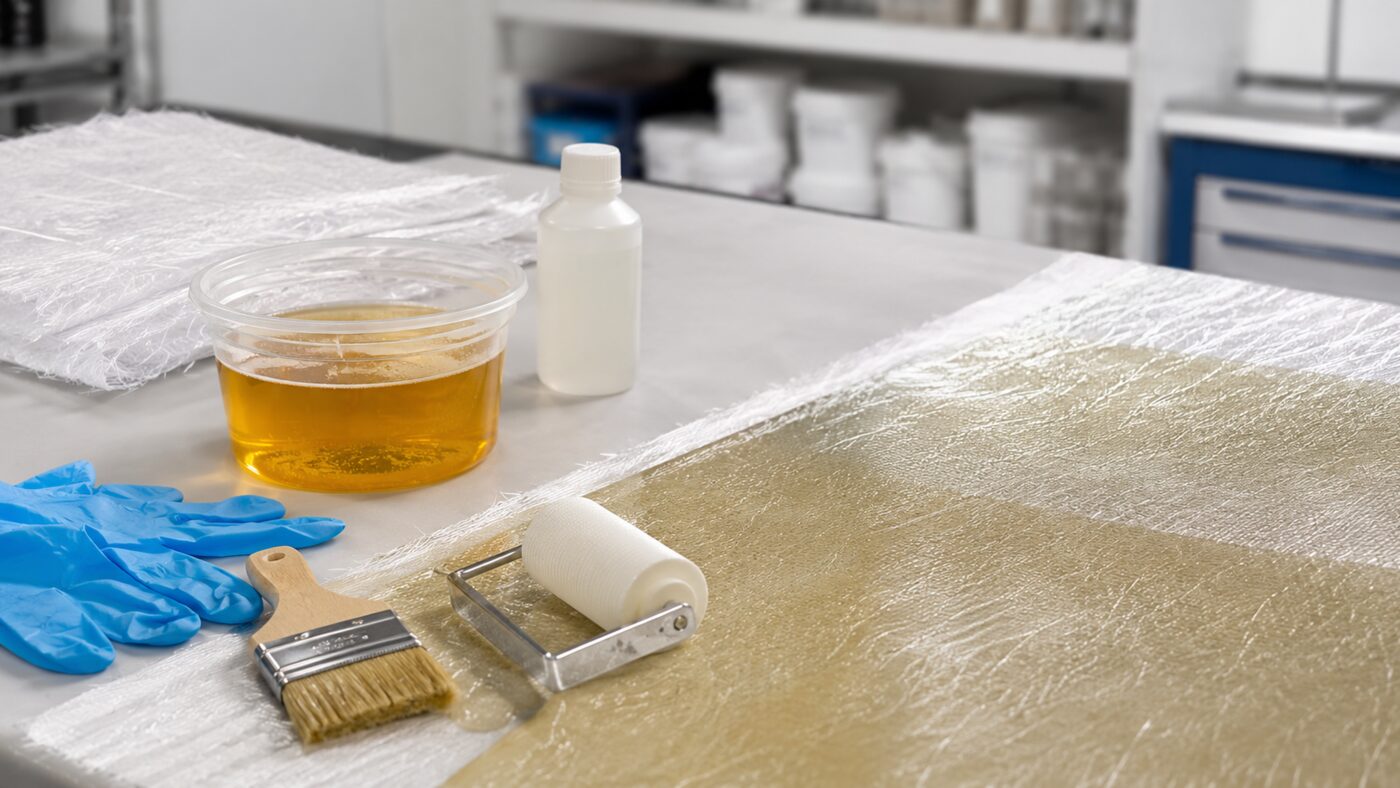
Our Recommendation
For classic GRP repairs, mould making, pond, pool, model and bodywork projects, polyester resin is particularly economical and easy to process with chopped strand mat. For beginners we recommend a reduced-styrene, tack-free curing laminating resin such as Polyester Resin Resinpal 1715 including the matching hardener.
What Is Polyester Resin?
Polyester resin is a thermosetting synthetic resin that cures when a suitable hardener is added. During laminating, it combines with reinforcement fibres to form glass-reinforced plastic, or GRP for short. The resin encloses the fibres, transfers loads and provides dimensional stability.
Polyester resin is most often processed with chopped strand mat. The styrene contained in polyester resin supports the wetting of the mat and helps to dissolve the binder of the chopped strand mat. This allows the mat to be draped well into curves, edges and repair areas.
Typical applications include boat repairs, bodywork, model making, mould making, GRP repairs, pond and pool coatings and larger laminate lay-ups where economy and fast processing are important.
Materials and Tools for GRP Laminating
Good preparation is essential when working with polyester resin. As soon as resin and hardener are mixed, the pot life starts. So have all cut pieces, tools and protective equipment ready before you mix.
| Material / tool | What it is needed for |
|---|---|
| Polyester resin + MEKP hardener | Resin system for laminates, repairs and building up GRP components |
| Chopped strand mat | Easy to drape, ideal for repairs, curves and surfaces |
| Woven glass fabric | For lighter and stronger laminates with a directional fibre structure |
| Laminating roller | For working out air bubbles and a better fibre-resin bond |
| Release agent | Required for mould making, female moulds and components that need to be demoulded |
| Protective equipment | Protective gloves, safety glasses and suitable respiratory protection for GRP work |
Mixing Ratio and Pot Life: What Matters?
Always take the exact mixing ratio from the product data sheet of the polyester resin you are using. As a guide, polyester resin is often processed with about 1 to 2 percent MEKP hardener relative to the amount of resin. For Resinpal 1715, the manufacturer specifies a hardener content of about 1.5 to 2 percent.
Measure resin and hardener with a scale or a suitable dosing aid. Too little hardener can lead to tacky or incompletely cured areas. Too much hardener shortens the pot life considerably and can promote uncontrolled heat development.
Practical tip: Mix several small batches rather than one large cup. Small quantities remain easier to control and can be processed cleanly before the resin gels.
Step by Step: Working with Polyester Resin and Laminating GRP
- Prepare the substrate: Clean, dry and degrease the surface and sand existing GRP surfaces. Remove sanding dust thoroughly.
- Cut the fibres: Cut chopped strand mat or woven glass fabric to size before mixing. For several layers, lay them out in the right order.
- Mix the resin: Weigh the polyester resin, add hardener according to the data sheet and stir thoroughly but calmly. Include the edge and bottom of the cup.
- Apply the first resin layer: Apply an even layer of resin to the prepared substrate with a brush or roller.
- Lay in the chopped strand mat: Place the mat in the fresh resin and wet it out from the centre outwards. White areas indicate fibres that are still dry.
- De-aerate: Work systematically over the surface with the laminating roller until air bubbles are visibly reduced and the fibres lie cleanly in the resin.
- Build up further layers: Apply further resin and fibre layers wet-on-wet or within the suitable processing window. De-aerate each layer again.
- Cure and finish: Let the laminate cure protected. Trim the edges, sand and, depending on the application, continue with gelcoat, topcoat or paint.
Typical Mistakes When Working with Polyester Resin
Polyester Resin or Epoxy Resin?
Polyester resin is often the economical choice for larger GRP surfaces, repairs to polyester GRP and projects with chopped strand mat. Epoxy resin, on the other hand, usually offers better adhesion and higher resistance, but is more expensive and often slower to process. An in-depth comparison can be found in the lexicon article Difference Between Epoxy Resin and Polyester Resin.
Expertise from Fiberglas Discount
Fiberglas Discount has been active in the field of glass-reinforced plastics since 1997. The product range is geared to practical GRP applications: resins, reinforcement fibres, release agents, tools and protective equipment are combined so that private and commercial users get clear solutions for laminating, repair and mould making.
Choose the Materials for Your GRP Project
For laminating with polyester resin, Fiberglas Discount offers suitable resins, chopped strand mat, woven glass fabric, laminating rollers and protective products.
View Resinpal 1715 View chopped strand matFrequently Asked Questions About Polyester Resin and GRP Laminating
Why Fiberglas Discount?
- Fiberglas Discount has been active in GRP and composite materials since 1997
- Practical selection of resins, fibres, tools and protective equipment
- Suitable complete solutions for repair, laminating, model making and mould making
Safety note: Polyester resin and MEKP hardener are chemical products. Read the safety data sheet and the manufacturer's information before processing. The information in this lexicon article does not replace a project-specific technical assessment.